
News & Events
FABRICARE comes to an end – the smart industry project spearheaded by Ceit to promote a new generation of collaborative, safe and efficient factories
FABRICARE comes to an end – the smart industry project spearheaded by Ceit to promote a new generation of collaborative, safe and efficient factories
A 3.4 million Euro initiative funded by the CDTI that combines integrated robotics, immersive interfaces and digital twins with a view to optimising processes and improving industrial safety.
16 | 12 | 2025
The project, coordinated by Ceit and developed together with Tecnalia, Ikerlan, CTC and Aidimme, validates the key technologies required to speed up the transition towards a more flexible, connected and data-based Industry 4.0
Industry is advancing towards more flexible and connected production models that are geared to data-based decision-making. This change, driven by technologies such as collaborative and mobile robotics, virtual and augmented reality, and cyber-physical systems, is transforming the way factories are designed, operated, and maintained. Within this context, FABRICARE has emerged as a strategic project that seeks to meet the growing demand for solutions that enable production times to be reduced, safety increased, and costs diminished through smarter and more efficient processes.
FABRICARE (Collaborative, safe and smart manufacturing using advanced interfaces, robotics and digital twins) has come to an end following intense research and development work that considered different technologies within the field of smart manufacturing in collaborative environments. Funded with 3.4 million Euros by the CDTI through the 2023 Cervera Grants for Technology Centres of Excellence, the project was led by Ceit and developed in collaboration with the technology centres Tecnalia, Ikerlan, CTC and Aidimme.
Integration of robotics, perception systems and digital twins
The integrated vision of FABRICARE focuses on improving current manufacturing processes through the deployment of collaborative and mobile robotics, reliable perception systems, and their direct connection to a simulation platform and digital twin-based modelling. This platform allows the behaviour of the production process to be predicted and analysed before implementation, while also facilitating real-time monitoring and control.
In addition to coordinating the project, Ceit contributed its knowledge and expertise to develop digital twins for simulation, new haptic interfaces, advanced controllers for collaborative manipulators, perception sensors for the environment, and mobile robot localization by merging optical techniques with radiofrequency. As Diego Borro, Ceit researcher and FABRICARE coordinator, highlights, “this project reinforces Ceit’s leadership in the development of technological solutions for the digital transformation of industry, consolidating a track record of over two decades of research in these technologies”.
The project’s final meeting was held at Ceit on 13th November, a session in which the outcomes were reviewed and the coordination and joint work of the consortium were highlighted. “The results have been very positive and reflect the excellent work done by the entire team,” Diego Borro emphasizes. The solutions developed by FABRICARE have demonstrated the potential to design factories in more flexible, automated, connected, safe, and smart environments.
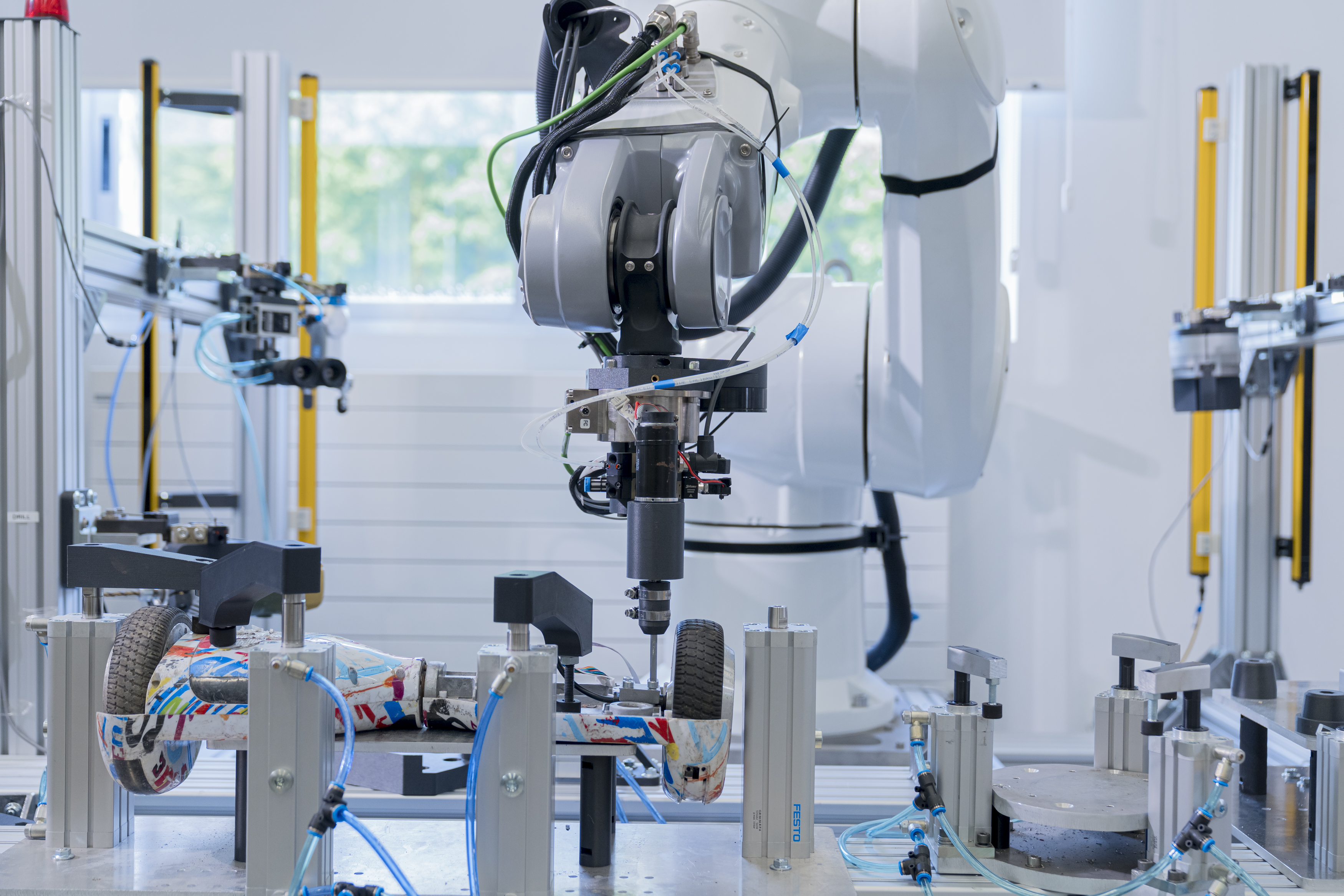
The demonstrator developed by Ceit is shown in the following video, combining automated and collaborative technologies, product inspection, and logistics using mobile robotics.