
News & Events
We’re fostering the development of next-generation resilient chips for critical sectors via the SoC4CRIS-II project
We’re fostering the development of next-generation resilient chips for critical sectors via the SoC4CRIS-II project
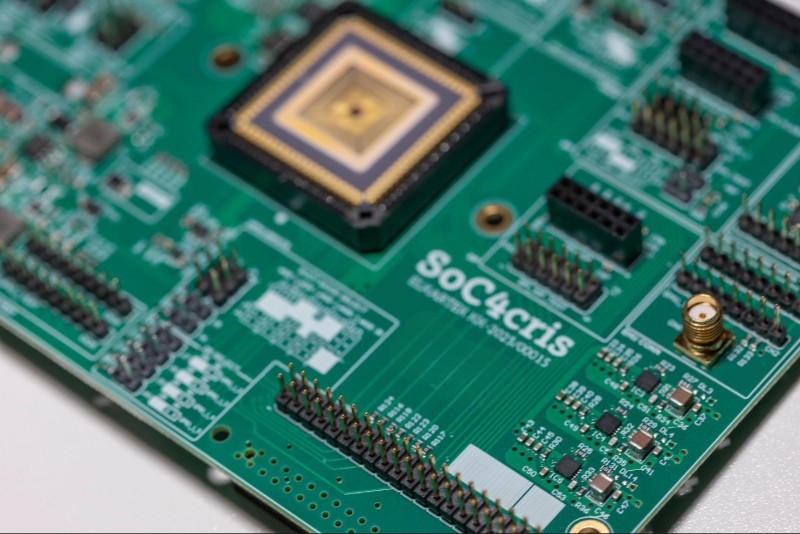
The project lends continuity to SoC4CRIS, a pioneer in the design of a complex chip in the Basque Country based on RISC-V architecture and which is advancing towards new capacities in terms of resilience, artificial vision and hybrid communications for industrial, energy and space applications.
16 | 03 | 2026
Within a global context marked by the shortage of semiconductors and the growing dependency on external technologies, Europe has placed strategic microelectronics at the heart of its industrial agenda. Initiatives such as the European Chips Act set out the target of reaching 20% of global semiconductor production by 2030, thus reinforcing digital autonomy and the resilience of critical sectors such as energy, advanced industry and space.
SoC4CRIS-II was launched within this framework as a continuation of the SoC4CRIS project, which enabled, for the first time in the Basque Country, the design of a complex chip based on open RISC-V architecture, integrating industrial communications, artificial vision, artificial intelligence and functional safety. This first phase represented a technological milestone, positioning the Basque ecosystem on the European map of advanced system-on-chip (SoC) design.
Next-generation chips for critical applications
The aim of this new phase is to develop next-generation chips with advanced resilience, artificial vision and hybrid communication capabilities, aimed at critical applications in which reliability, energy efficiency and safety are essential requirements.
One of the strategic pillars of the project is the design in 22 nm nodes, with manufacturing in European foundries such as GlobalFoundries in Germany. These advances will enable the development of more integrated, efficient and powerful chips, optimising consumption, performance and integration density — key factors for industrial and aerospace environments.
SoC4CRIS-II also incorporates architectures resilient to cosmic radiation, a critical capability for space devices and increasingly demanded in high-reliability terrestrial applications such as energy infrastructures or advanced industrial systems. The project also includes the development of artificial vision coprocessors for real-time image and video processing, as well as processors synchronised at a sub-nanosecond level, which will open the door to new applications in distributed analysis and hybrid conventional–quantum communications.
Ceit’s contribution
Within this context, Ceit will focus its research on optimising radiation-tolerance techniques applied to the RISC-V microcontroller designed by the centre itself for space applications. The work will begin with FPGA prototyping, validating architectures and fault-mitigation mechanisms, with the ultimate goal of implementing them in an ASIC using 22 nm technology.
This contribution is directly aligned with two of the project’s main objectives: design in advanced European nodes and the development of architectures robust against radiation effects, reinforcing knowledge transfer towards industrialisable solutions for strategic sectors.
The project is part of the Elkartek funding programme of the Basque Government and is led by the APERT research group of the University of the Basque Country. Alongside Ceit, the technology centres Tekniker and Ikerlan, the company Connect Group and the GAIA cluster are also participating.